
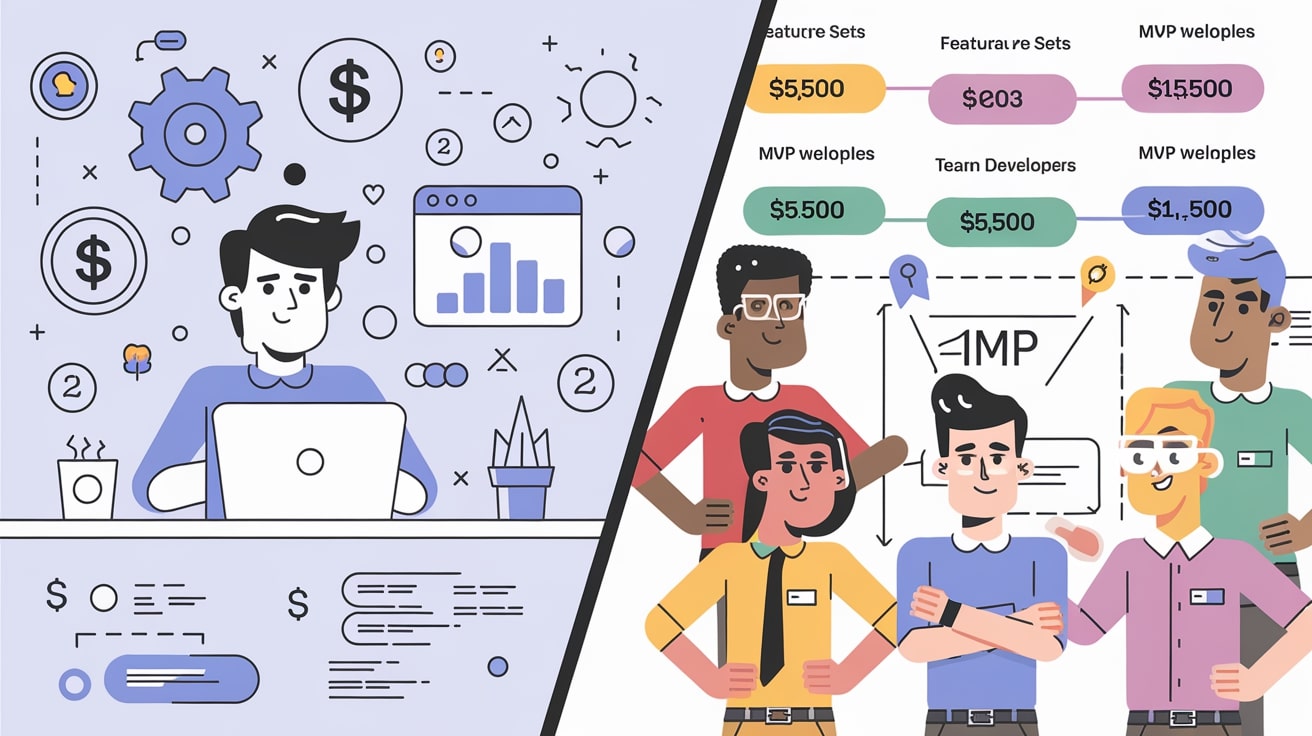
Ask five developers what it costs to build an MVP website, and you’ll get five different answers—ranging from $5,000 to $150,000. That’s not helpful when you’re trying to create a budget. The truth is, MVP website costs depend on a constellation of factors: your feature set, development approach, team location, and dozens of smaller decisions that add up quickly.
This guide breaks down exactly what you’ll pay to build an MVP website, with specific numbers for each development phase, realistic cost ranges by project type, and strategies to maximize your budget. No more guessing—just the numbers you need to plan.
MVP Website Cost by Complexity Level
The biggest factor in MVP website cost is complexity. Below is what to expect at each tier:
Simple MVP ($5,000 – $20,000)
What’s included: Landing page, user authentication, 1-2 core features, basic admin panel, standard design using templates or component libraries.
Timeline: 4-8 weeks
Examples: Basic task management app, simple booking system, content publishing platform, newsletter service with subscriber management.
Simple MVPs are perfect for validating a single core hypothesis. If your product’s value proposition can be tested with minimal functionality, this is your target range.
Moderate Complexity MVP ($20,000 – $50,000)
What’s included: User accounts with profiles, CRUD operations, payment processing, admin dashboard, 3-5 integrations, custom design, responsive layout.
Timeline: 8-14 weeks
Examples: E-commerce platform, subscription SaaS, project management tool, membership site with gated content.
Most startup MVPs fall into this category. You have enough functionality to deliver real value while staying lean enough to iterate quickly.
Complex MVP ($50,000 – $120,000+)
What’s included: Real-time features, multiple user roles and permissions, AI/ML integration, complex data relationships, marketplace dynamics, extensive third-party integrations, polished custom design.
Timeline: 14-24 weeks
Examples: Two-sided marketplace, real-time collaboration platform, fintech application, healthcare platform with compliance requirements.
Complex MVPs require significant investment but are sometimes necessary when simpler versions can’t adequately test the core value proposition.
Cost Breakdown by Development Phase
Understanding where your money goes helps you make smarter trade-offs. Here’s how MVP website development costs typically break down:
Design and Prototyping (15-25% of total)
| Component | Cost Range | Timeline |
|---|---|---|
| UX Research & Wireframes | $2,000 – $10,000 | 1-3 weeks |
| UI Design | $2,500 – $15,000 | 2-4 weeks |
| Interactive Prototype | $1,500 – $8,000 | 1-2 weeks |
Design costs vary enormously based on your requirements. Using pre-built component libraries (like Shadcn/ui or Material UI) can reduce UI costs by 40-60% while still achieving a polished look.
Front-End Development (25-35% of total)
| Component | Cost Range | Timeline |
|---|---|---|
| Core Interface | $8,000 – $35,000 | 4-8 weeks |
| Responsive Design Implementation | $2,000 – $8,000 | 1-2 weeks |
| Animation & Interactivity | $1,000 – $5,000 | 1 week |
Your choice of technology stack significantly impacts front-end costs. As we covered in our guide to the best tech stack for MVP websites, mainstream frameworks like React or Vue.js offer the best balance of developer availability and development speed.
Back-End Development (30-40% of total)
| Component | Cost Range | Timeline |
|---|---|---|
| API Development | $10,000 – $45,000 | 4-10 weeks |
| Database Design & Setup | $2,000 – $10,000 | 1-3 weeks |
| Authentication System | $1,500 – $6,000 | 1-2 weeks |
| Third-Party Integrations | $2,000 – $15,000 | 2-4 weeks |
Back-end development is typically the largest cost category. Using Backend-as-a-Service platforms like Supabase or Firebase can reduce these costs by 30-50% for simpler applications.
Testing & Quality Assurance (10-15% of total)
| Component | Cost Range | Timeline |
|---|---|---|
| Functional Testing | $2,000 – $8,000 | 1-3 weeks |
| User Acceptance Testing | $1,500 – $5,000 | 1-2 weeks |
| Bug Fixes | $2,000 – $10,000 | 2-4 weeks |
Skimping on QA is a false economy. Bugs found post-launch cost 3-5x more to fix than those caught during development.
Deployment & Launch (5-10% of total)
| Component | Cost Range | Timeline |
|---|---|---|
| Server Setup & Configuration | $1,000 – $4,000 | 1 week |
| CI/CD Pipeline | $1,000 – $3,000 | 1 week |
| Security Configuration | $1,000 – $5,000 | 1 week |
No-Code vs. Custom Code: The Cost Comparison
One of the most impactful decisions for your MVP website cost is whether to use no-code platforms or custom development. We’ve detailed the strategic considerations in our no-code vs. custom code guide. Here’s the financial breakdown:
No-Code MVP Websites
- Initial development: $3,000 – $15,000
- Monthly platform fees: $100 – $500
- Timeline: 2-6 weeks
- 2-year total cost: $5,400 – $27,000
Best for: Validating concepts quickly, non-technical founders, simple to moderate complexity, limited budget.
Limitations: Scalability ceiling, customization constraints, platform dependency, potential migration costs later.
Custom-Coded MVP Websites
- Initial development: $20,000 – $80,000
- Monthly hosting: $50 – $300
- Timeline: 8-20 weeks
- 2-year total cost: $21,200 – $87,200
Best for: Complex requirements, scaling ambitions, unique functionality, long-term product development.
Advantages: Full flexibility, better performance at scale, no platform dependencies, complete ownership.
The Hybrid Approach
Many successful startups launch with no-code to validate, then migrate to custom code after proving product-market fit. This approach minimizes initial investment while preserving long-term flexibility. Budget $15,000-$40,000 for the migration when the time comes.
Hidden and Ongoing Costs
The development quote isn’t your total cost. Smart founders budget for these often-overlooked expenses:
Infrastructure and Hosting
| Service | Monthly Cost |
|---|---|
| Cloud Hosting (AWS, Vercel, etc.) | $50 – $500 |
| Database Hosting | $20 – $200 |
| CDN & Storage | $20 – $100 |
| Domain & SSL | $10 – $50 |
Annual infrastructure cost: $1,200 – $10,200
Third-Party Services
| Service | Monthly Cost |
|---|---|
| Authentication (Auth0, Clerk) | $0 – $300 |
| Email Service (SendGrid, Postmark) | $20 – $100 |
| Analytics (Mixpanel, Amplitude) | $0 – $200 |
| Error Monitoring (Sentry) | $0 – $100 |
| Payment Processing (Stripe fees) | 2.9% + $0.30 per transaction |
Annual third-party cost: $500 – $8,400 (excluding payment processing)
Post-Launch Maintenance
According to industry research, software maintenance typically costs 15-20% of initial development costs annually. For a $40,000 MVP, budget $6,000-$8,000 per year for:
- Bug fixes and performance optimization
- Security patches and updates
- Dependency updates
- Minor feature improvements
The Complete First-Year Budget
For a moderate complexity MVP website, here’s a realistic first-year budget:
| Category | Cost Range |
|---|---|
| Initial Development | $25,000 – $50,000 |
| Infrastructure (12 months) | $1,200 – $6,000 |
| Third-Party Services (12 months) | $1,000 – $5,000 |
| Post-Launch Iterations | $5,000 – $15,000 |
| Maintenance | $4,000 – $10,000 |
| Total First-Year Investment | $36,200 – $86,000 |
Cost by Development Team Location
Where your developers are located dramatically impacts your budget. If you’re considering hiring an MVP developer, regional rates significantly affect total project cost:
| Region | Hourly Rate | Moderate MVP Cost |
|---|---|---|
| United States | $100 – $200 | $60,000 – $150,000 |
| Western Europe | $80 – $150 | $50,000 – $120,000 |
| Eastern Europe | $40 – $80 | $25,000 – $60,000 |
| Latin America | $40 – $75 | $25,000 – $55,000 |
| Asia | $20 – $50 | $15,000 – $40,000 |
Lower rates don’t always mean lower quality, but they do require more careful vetting. Communication challenges and time zone differences can offset some cost savings if not managed properly.
10 Strategies to Reduce MVP Website Costs
Whether your budget is $20,000 or $100,000, these strategies help you get more value for every dollar:
1. Ruthlessly Prioritize Features
Use the MoSCoW method: Must-have, Should-have, Could-have, Won’t-have. Build only the Must-haves for v1. Every feature you cut saves $2,000-$10,000.
2. Use Pre-Built Components
Component libraries like Shadcn/ui, Material UI, or Tailwind templates can cut front-end development time by 30-50%. Don’t pay for custom buttons when proven solutions exist.
3. Leverage Backend-as-a-Service
Platforms like Supabase, Firebase, or AWS Amplify handle authentication, databases, and real-time features out of the box. You pay for hosting instead of development hours.
4. Start with No-Code, Migrate Later
If your concept can be tested with no-code tools, start there. A $10,000 no-code MVP that validates your idea is better than a $50,000 custom MVP built on assumptions.
5. Use Third-Party Services
Don’t build what you can buy. Stripe for payments, Auth0 for authentication, SendGrid for email, Algolia for search—each integration saves weeks of development.
6. Design with Templates
Purchase a $50-$200 design template and customize it rather than starting from scratch. Your MVP doesn’t need a completely unique visual identity.
7. Consider Cross-Platform Frameworks
If you need mobile apps, frameworks like React Native or Flutter let you build for iOS and Android from one codebase, potentially cutting mobile development costs by 40%.
8. Outsource Strategically
Consider a hybrid approach: US-based architect for system design, offshore developers for implementation. You get senior expertise where it matters most at blended rates.
9. Implement Early and Often
Agile development with frequent deployments catches problems early. Fixing a bug in development costs a fraction of fixing it post-launch.
10. Plan for Iterations
Reserve 20-30% of your budget for post-launch improvements. The first version is never perfect—budget for the learning that comes from real users.
What Should You Actually Budget?
Based on your funding stage and goals, here’s practical budgeting guidance:
Bootstrapped / Pre-Seed ($10,000 – $30,000)
Use no-code or low-code platforms. Focus on a single core feature. Accept design compromises. Validate before investing more.
Seed Stage ($30,000 – $75,000)
Custom development with experienced team. 3-5 core features. Professional design. Room for iteration based on user feedback.
Series A+ ($75,000 – $150,000+)
Full custom development. Comprehensive feature set. Polished design. Scalable architecture. Extensive testing and security.
According to Y Combinator’s guidance, most startups should allocate 30-50% of seed funding to product development. Plan your MVP budget within that framework.
The Bottom Line
MVP website costs range from $5,000 for a simple no-code solution to $150,000+ for a complex custom platform. Most startups land somewhere in the $25,000-$60,000 range for a custom-built MVP that can effectively test their core hypothesis and attract early users or investors.
The key isn’t finding the cheapest option—it’s maximizing the value of every dollar. Focus on core features, leverage existing solutions, choose the right development approach for your stage, and budget for the iterations that will inevitably follow launch.
Your MVP is an investment in learning. Spend enough to learn what matters, but not so much that you can’t afford to act on what you discover. When you’re ready to build your MVP app, let these cost guidelines shape your planning.
Frequently Asked Questions
What’s the minimum budget for an MVP website?
You can build a functional MVP for $5,000-$10,000 using no-code platforms like Bubble or Webflow. For custom development, expect a minimum of $15,000-$20,000 for the simplest applications. Anything below these thresholds typically involves significant compromises.
How much should I budget for ongoing costs after launch?
Budget $500-$1,500 per month for infrastructure, third-party services, and basic maintenance. Additionally, reserve 15-20% of your initial development cost annually for maintenance and updates. For a $40,000 MVP, that’s approximately $6,000-$8,000 per year.
Is no-code cheaper in the long run?
Not always. No-code has lower upfront costs but higher monthly fees. Over 2-3 years, a no-code solution may cost as much as custom development—and you’ll still need to pay for migration if you outgrow the platform. No-code is best for rapid validation before committing to custom development.
How can I reduce MVP website costs without sacrificing quality?
Focus on fewer features (build only what’s essential to test your hypothesis), use pre-built components and third-party services, consider Eastern European or Latin American developers for better value, and start with a discovery phase to nail down requirements before development begins.
Have questions about MVP website costs? Drop a comment below—we read and respond to every one.